
How ESPR is Reshaping Furniture Design: 5 Critical Changes Manufacturers Must Make
The EU's Ecodesign for Sustainable Products Regulation (ESPR) isn't just another compliance checkbox; it's fundamentally changing how furniture will be designed, manufactured, and brought to market. For companies operating in or exporting to the EU, the message is clear: sustainable design is no longer optional.
While the furniture industry has long grappled with sustainability concerns, ESPR introduces legally binding requirements that will force manufacturers to rethink their entire design philosophy. From the materials you select to how products can be disassembled at end-of-life, every design decision now carries regulatory weight and financial implications.
Let’s explore the 5 design changes companies need to prioritize.

1. Product Longevity: Building Furniture That Lasts (and Can Be Fixed)
Planned obsolescence is no longer an acceptable business model. The public sniffs right through it, and so do the regulators.
“ESPR demands that furniture be designed with longevity at its core, prioritizing upgrading, reuse, remanufacturing, and refurbishment capabilities.”
What this means for design:
Your design team must now consider the entire lifecycle from the very first sketch. Can that sofa be reupholstered easily? Are the chair legs replaceable without specialized tools? Can drawer mechanisms be swapped out when they wear down?
This shifts the design paradigm from "create and dispose" to "create, maintain, and extend." Modular construction becomes not just a trendy feature but a regulatory necessity. Connection points need to be standardized. Components must be accessible. Assembly methods should facilitate disassembly.
For furniture manufacturers, this could actually unlock new revenue streams—offering refurbishment services, selling replacement components, and building customer relationships that extend far beyond the initial sale. But it requires design teams to think in terms of decades, not just the warranty period.
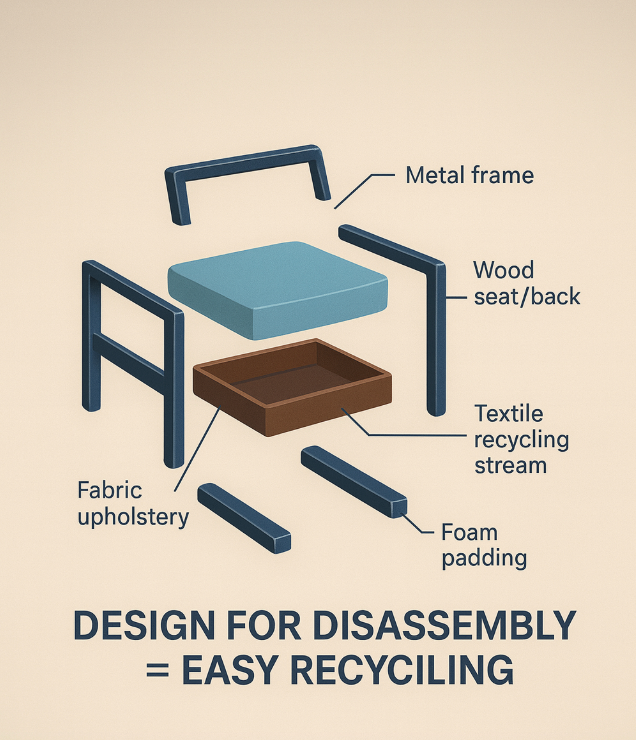
2. Recyclability by Design: Making Disassembly as Important as Assembly
ESPR doesn't just want furniture to be recyclable in theory—it demands that products be designed with recyclability as a fundamental principle. This means using easily recyclable materials and ensuring that components can be accessed and separated at end-of-life.
What this means for design:
Material selection becomes exponentially more complex. That innovative composite material might offer incredible durability, but if it can't be recycled, it's likely incompatible with ESPR requirements. Mixed materials, like wood frames with permanently bonded foam and fabric, create recycling nightmares that regulations now penalize.
Design for disassembly (DfD) principles must be embedded from day one. This means:
Minimizing adhesives in favor of mechanical fasteners
Creating clear separation points between different material types
Labeling materials clearly for recyclers
Designing joints that can be unbolted rather than cut apart
Choosing mono-materials where possible
The irony? Furniture designed for easy recycling is often furniture that's easier to repair and refurbish, too. What seems like a constraint might actually improve your product's overall value proposition.
3. Eliminating Unsustainable Design Choices: The End of Disposable Thinking
ESPR explicitly prohibits designs that hinder upgrading, reusing, remanufacturing, and refurbishment. Any technical solution or design choice that creates barriers to circularity is now potentially non-compliant.
What this means for design:
Certain design conveniences that manufacturers have relied on for years will need to be phased out:
Permanently bonded components that can't be separated
Proprietary fasteners that require specialized tools
Integrated electronics that can't be replaced independently
Single-use structural elements that fail when disassembled
Material combinations that are inseparable
“This forces a fundamental question at every design review: "Does this design choice make the product harder to repair, upgrade, or recycle?" If the answer is yes, you need a compelling justification—or a design revision.”
For design teams accustomed to optimizing for manufacturing speed and cost reduction, this represents a significant mindset shift. The lowest-cost manufacturing option may no longer be the most sustainable option, and sustainability now has regulatory teeth.
4. Toxic Substance Restrictions: Clean Materials from Start to Finish
ESPR's restrictions on toxic substances go beyond just avoiding obviously harmful chemicals. Manufacturers must ensure no materials from toxic substances lists are incorporated into their furniture, and they must minimize releases of concerning materials—including nanoplastics—throughout the product lifecycle.
What this means for design:
Your material supply chain suddenly requires much deeper scrutiny. It's not enough to know what your direct suppliers provide—you need transparency all the way down to raw material sources.
Finishes, adhesives, flame retardants, and treatments all come under the microscope. That stain-resistant coating might contain PFAS chemicals. Those foam cushions might release concerning particles over time. The pressure-treated wood might contain restricted substances.
Nanoplastics represent a particularly emerging concern. As materials degrade through use and exposure, are they releasing micro- or nano-scale plastic particles? Design choices that minimize material degradation, better protective finishes, reinforced stress points, higher-quality base materials, become not just quality improvements but regulatory necessities.
“This also means maintaining comprehensive material documentation. Under ESPR, a Digital Product Passport (DPP) must accompany regulated products, tracking substances of concern, repairability, material composition, and end-of-life data.”
For furniture, data gaps often appear in adhesives, foams, and coatings, areas where suppliers rarely share full formulations, forcing brands to renegotiate contracts or replace non-transparent vendors. Digital Product Passports will require detailed disclosure of what's in your products, creating an unprecedented level of material transparency.
5. Resource Efficiency: Optimizing Weight, Volume, and Consumption
ESPR pushes manufacturers to optimize product weight, volume, and consumables—essentially demanding that furniture accomplish its function with the minimum resource input possible.
What this means for design:
Material efficiency becomes a core design metric. Can you achieve the same strength with less material? Can packaging be reduced? Can dimensions be optimized to improve shipping efficiency?
This could drive significant innovation in furniture categories that have remained relatively unchanged for decades:
Lightweight materials that maintain structural integrity
Flat-pack designs that minimize shipping volume
Modular systems that eliminate redundant components
Designs that eliminate or minimize consumables (like batteries or filters)
For certain product categories, this might require fundamental redesigns. That heavy, solid wood dining table might need to justify its weight, or explore engineered materials that provide similar aesthetics and durability with significantly less resource consumption.
Packaging also falls under this umbrella. Excessive packaging is both a cost center and an environmental concern. Designing products that can be safely shipped with minimal protective materials becomes a competitive advantage.
The Design Revolution Is Here
ESPR represents more than regulatory compliance; it's a fundamental reimagining of what good furniture design means. The most successful furniture manufacturers won't be those who grudgingly meet minimum requirements, but those who embrace these principles as design opportunities.
Furniture designed for longevity, repairability, and recyclability isn't just better for the environment—it's often better quality, more valuable to customers, and opens new business models around services and circularity.
The design changes required by ESPR are substantial, but they're also inevitable. Manufacturers who start integrating these principles now will be market leaders when enforcement begins. Those who wait will find themselves scrambling to redesign entire product lines under regulatory pressure.
“Compliance is becoming a condition for market access, not just a sustainability credential. The EU’s ESPR enforcement framework empowers member states to impose substantial fines or restrict sales for non-compliant products, and marketplaces like Amazon or Zalando are expected to delist furniture missing a DPP.”
The question isn't whether your design process will change—it's whether you'll lead that change or be forced to follow it.
How CarbonSync Helps Furniture Companies Navigate ESPR Design Changes

Understanding what ESPR requires is one challenge. Actually implementing these design changes across your entire product portfolio—while managing costs, timelines, and existing manufacturing processes—is another challenge entirely.
The Traditional Approach: Slow, Expensive, Consultant-Heavy
Until now, furniture manufacturers tackling complex sustainability regulations have typically followed a consultant-driven approach:
Hiring specialized consultants for 6-12 month engagements costing $50,000-$150,000+ per assessment. These experts manually audit your materials, review designs against compliance checklists, and produce lengthy reports recommending changes.
Manual material tracking where your procurement team spends weeks chasing down documentation from suppliers, cross-referencing component specs against restricted substance lists, and maintaining spreadsheets that become outdated the moment anything changes.
Reactive problem-solving where compliance issues surface late in development—after designs are finalized, tooling is ordered, and launch dates are set—forcing expensive redesigns and delays.
Fragmented documentation scattered across emails, PDFs, supplier portals, and engineering systems, making it nearly impossible to assemble the comprehensive Digital Product Passports ESPR mandates.
The result? Furniture companies spend enormous time and money on compliance that doesn't improve their products or competitiveness—and still risk missing critical requirements buried in hundreds of pages of regulations.
The CarbonSync Difference: AI-Powered Compliance at Lightning Speed
CarbonSync transforms ESPR compliance from a months-long consultant project into an AI-powered workflow that integrates directly into your design process.
Instant Material Intelligence Upload your bill of materials and our AI immediately identifies compliance risks: restricted substances, non-recyclable composites, materials that hinder disassembly. What took consultants weeks analyzing spreadsheets now happens in minutes.
Upload your bill of materials and our AI immediately maps your data to our LCA engine and flags compliance risks like presence of hazardous materials.
Move away from spend-based LCA:
CarbonSync imports all your supplier data and maps process energy use to your products - this sets the foundation that allows you to move away from spend-based LCA
Automatic Digital Product Passport Generation Instead of manually compiling documentation from dozens of sources, CarbonSync generates ESPR-compliant Digital Product Passports automatically from your existing product data, updating them continuously as materials or designs evolve.
Predictive Compliance Modeling Before committing to a design direction, see exactly how different material choices, assembly methods, and configurations impact your ESPR compliance profile. Make informed trade-offs between cost and performance, while changes are still easy and inexpensive.
Real Impact: Faster, More Affordable, More Accurate
Furniture manufacturers using CarbonSync typically see:
Continuous monitoring instead of point-in-time audits that become outdated
Faster time-to-market with compliance built into design workflows, not added afterward
Scalable data foundation - reduce manual data collection time by 60%
The furniture companies leading ESPR compliance aren't spending months with consultants reviewing spreadsheets—they're using AI to embed compliance directly into how they design.
Ready to Accelerate Your ESPR Compliance?
ESPR is reshaping furniture design whether you're ready or not. CarbonSync ensures you’re moving faster than your peers.
“Take your free ESPR assessment test here.”


